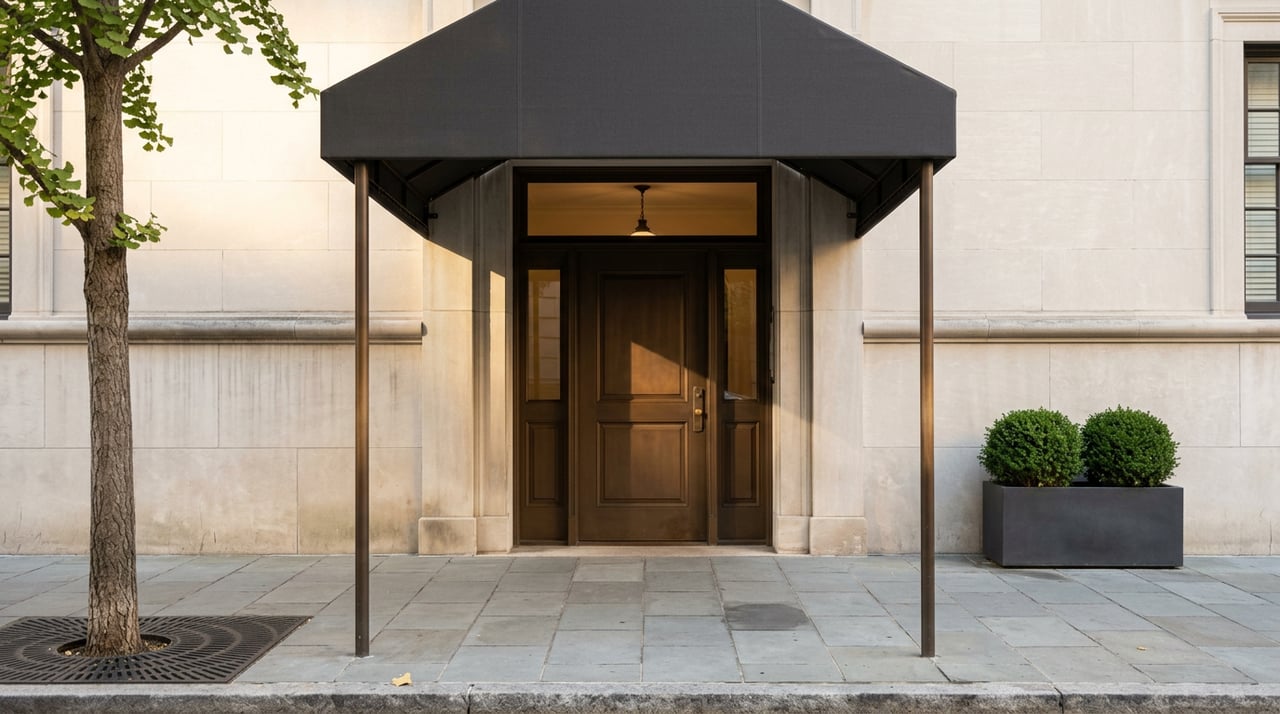
Sutton Place Condo vs Co-op Prices in 2026: What Buyers Get
August 6, 2026
August 6, 2026
A buyer comparing Sutton Place against Park and Fifth opens the portal and sees two numbers that seem to tell a story. The median condo price in Sutton Place in November was $4.5M, up 137.7% year-over-year, while the median co-op sale price was $775K, a change of -13.2% year-over-year. The obvious read is that the enclave has repriced upward on the condo side and softened on the co-op side, and that the smart trade is to buy new construction before the gap widens further.
The number is real. The story it tells is wrong.
There is very little condominium product inside the historic core of Sutton Place. 40 Sutton Place holds the distinction of being the only condominium building in Manhattan's prestigious Sutton Place enclave, a 10-story building with 74 apartments built in 1954 and converted to condominiums in 1981. Everything else that trades as a condominium here is either on First Avenue, on the side streets, or in the tall new tower a few blocks north.
That tower is doing the work. Sutton Tower is the first residential tower designed by Thomas Juul-Hansen, rising 850 feet and containing 120 one- to five-bedroom condos with views stretching from the East River to the Atlantic Ocean. Its penthouse listed at $65 million. When a handful of Sutton Tower units close in a given quarter inside a neighborhood that trades in low volume, they move the condo median by tens of percent. That is what happened.
If you strip Sutton Tower out, the condo tape looks nothing like $4.5M. Recent sales at 40 Sutton Place average roughly $959 per square foot, with current for-sale asks around $1,062. That is a different building, a different price band, and a different buyer.
The co-op median is the more honest number, and it is still misleading. It averages the 500-square-foot studio in a First Avenue postwar building with a full-floor prewar on the river. Break the tape apart by address and the picture reorganizes.
| Building | Recent sales avg $/sf | Current asks avg $/sf |
|---|---|---|
| River House, 435 E 52nd | ~$1,153 | ~$1,524 |
| One Sutton Place South | ~$1,241 | ~$2,879 |
| 40 Sutton Place (condo) | ~$959 | ~$1,062 |
| 35 Sutton Place | ~$775 | ~$812 |
Sources: CityRealty building pages, as of mid-2026.
Two things fall out of this. The first is that the spread between recent sales and current asks at the most storied addresses is wide. One Sutton Place South currently shows an average ask of $2,879 per square foot against recent sales averaging $1,241. A seller at that address is asking a buyer to close the gap based on scarcity, board pedigree, and view line, not comparable prints. The second is that the "discount to Park and Fifth" that Sutton is often described as offering is real but concentrated in the middle of the market, not at the trophy tier.
A working range for the prewar co-op tape in mid-2026: a renovated two-bedroom co-op with river views in a prime Sutton Place building may trade between $1.5M and $3M; three- and four-bedroom apartments with direct river exposure in the best prewar buildings range from $3M to $8M or more; townhouses, when they appear, can exceed $10M; price per square foot varies from $1,200 in unrenovated units to $2,500 or above in premium river-facing apartments.
The reason the co-op median looks soft is not that the co-ops are cheap. It is that the pool of buyers who clear the board is small, and that pool shrinks every time interest rates move or a family office rebalances toward liquid assets. The board is a filter on demand, and a filter on demand is a filter on price.
Sutton Place co-ops are among the most traditional in Manhattan. Boards in this neighborhood tend to be conservative, often requiring down payments of 30 to 50 percent, substantial post-closing liquidity, and debt-to-income ratios that leave wide margins. Subletting is restricted or prohibited in most buildings. Pied-à-terre purchases are evaluated on a building-by-building basis, with some of the most exclusive addresses requiring primary residency.
What that means at the offer stage:
This is the friction the median hides. It is also why the co-op discount to a Park Avenue building of similar vintage is not a mispricing waiting to be arbitraged. It is compensation for a narrower resale pool.
The one place the buyer's math actually favors the co-op is the closing statement. Co-op buyers in Sutton Place avoid the NYC Mortgage Recording Tax, a saving of 1.8 to 1.925 percent of the loan amount, because co-op shares are classified as personal property. For a buyer financing $1.5M, this represents a saving of approximately $29,000 at closing.
Scale that up. On a $4M Sutton Tower condo with a $2M loan, the mortgage recording tax alone runs roughly $38,000 to $39,000. On a $4M prewar co-op with the same loan, it is zero. Add title insurance, which the condo buyer pays and the co-op buyer generally does not, and the closing-cost delta between the two ownership structures at the same purchase price can approach six figures before anyone talks about ongoing carry.
The condo buyer gets that back over time in flexibility. The co-op buyer gets it back at the closing table. Which one matters more depends on how long the buyer plans to hold.
Sutton Square itself is not the broader Sutton Place market and should not be comped against it. It is a five-house cul-de-sac at the foot of East 58th Street, adjacent to the private Riverview Terrace. A smaller inventory of townhouses, primarily along Sutton Place, Sutton Square, and the private Riverview Terrace, offers buyers the rarest residential product in the neighborhood: single-family homes on the East River with private gardens, direct river views, and the architectural character of the 1920s originals.
These houses trade a handful of times a decade. When they do, they price against memory and against private-sale precedent, not against the portal median. A buyer approaching Sutton Square with a spreadsheet built from Redfin's neighborhood average will underprice the offer and lose the house. A buyer approaching with a spreadsheet built from the last three trades on the block, adjusted for river frontage and garden footprint, will be in the conversation.
StreetEasy's May 9, 2026 snapshot showed 326 homes for sale in Sutton Place, a neighborhood median asking price of about $1.195M, and an average asking price of about $1,331 per square foot. Days on market vary by source and cut, running from the low seventies to over a hundred depending on whether the count includes long-listed sponsor units at Sutton Tower.
The signal in that spread: this is not a market where speed is the constraint. The constraint is match. A well-priced two-bedroom in a well-run prewar building with a reasonable board still finds a buyer in a normal timeframe. A three-bedroom with a difficult layout in a building with a maintenance question mark can sit for six months at any price, because the buyers who can clear the board also know how to read a financial statement.
That is the market Sutton Place actually runs on. The $4.5M condo median is a headline. The trade is elsewhere.
If you are weighing a Sutton Square or Sutton Place purchase against a Park Avenue or Fifth Avenue alternative and want a read on which specific buildings, floors, and lines are worth pursuing at current pricing, Andres Perea-Garzon is available for a private conversation. Let's Connect.
Stay up to date on the latest real estate trends.


Operating at the highest levels of Manhattan real estate, delivering strategic guidance, discretion, and precision across complex, high-value transactions.